What is Native?
Over the past few years, crypto has matured from a market of first-time buyers into one built around products with established, verified user bases. Exchanges with millions of onboarded users. Custodial wallets that ran KYC at sign-up. Neobanks with compliance programmes and users who have been transacting for years.
These products know exactly who their users are, and the initial identity work is already done.
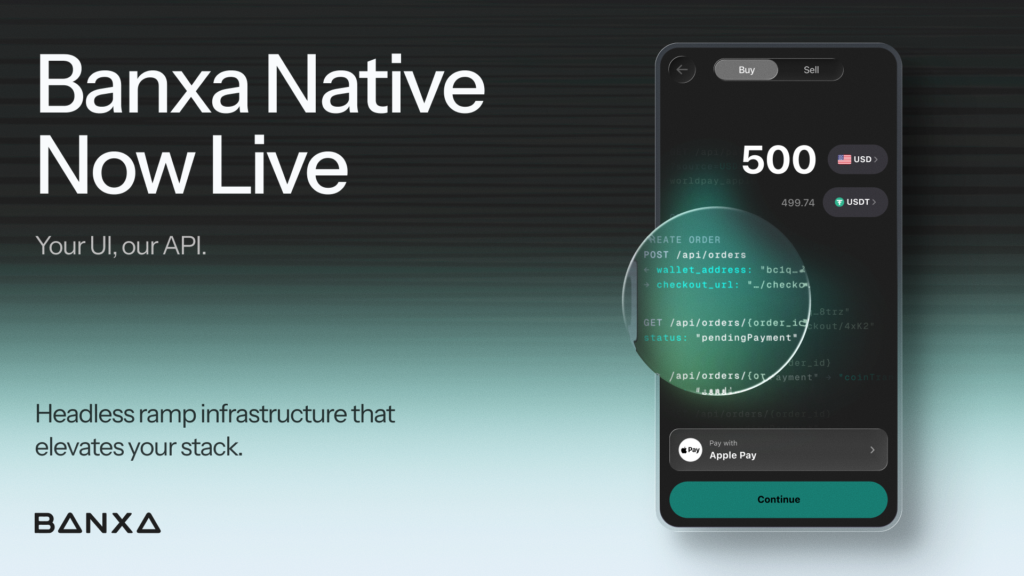
Banxa Native is headless ramp infrastructure built for where the market is now. It powers the checkout flow behind the scenes, inside the partner’s product.
Headless infrastructure
Headless infrastructure means that users never leave the product. Banxa operates seamlessly in the background as the regulated provider of record, identified at the point of transaction, invisible everywhere else. No Banxa-branded UX, no redirects, the user experience belongs to the partner. Banxa powers the transaction behind the scenes as the licensed provider, so partners keep the experience and Banxa carries the regulatory load.
Most headless ramp products still need a webview for bank payments and run a parallel identity check on top of yours. Banxa Native skips the webview, and it reuses your existing KYC rather than running a duplicate check, where Banxa’s compliance requirements allow.
If you want the longer version of why headless matters, we broke it down
here.
Payment methods users already trust
Native plugs the highest-converting, most familiar payment methods directly inside the partner’s product. Apple Pay, Google Pay, card payments, and bank transfers, all running natively. Apple Pay alone is consistently the highest-converting payment method in mobile commerce and having it appear as a native screen inside your app is a very different experience from routing them through a third-party checkout to do the same thing.
Bank transfers run entirely through the API, no SDK or webview required.
What Banxa Native offers
| What Banxa Native offers |
What that means |
| Verification carries through |
Returning users benefit from streamlined verification, previously completed identity checks can be securely shared via tokenization, subject to Banxa’s compliance and regulatory requirements, so eligible users move straight to payment. |
| Full UX ownership |
No Banxa-branded screens, no redirects. The payment experience lives inside the partner’s product, with Banxa named as the regulated provider at the point of payment. |
| Bank transfers via API |
Bank flows run entirely through the API. No SDK or webview required. |
| Apple Pay, Google Pay, and cards without PCI burden |
Partners get native payment methods without holding PCI certification themselves. Card execution runs through a PCI-certified environment. |
| Compliance that works with existing stacks |
Four identity models built for partners who already own their compliance infrastructure. |
| Eligibility evaluated per transaction |
Users are asked for additional information only when the specific transaction requires it. Not at onboarding, not on every transaction. |
Minimal friction for new users
Every transaction in Banxa Native starts with an eligibility check. For a returning verified user, the process is fast, the endpoint looks up their existing record and confirms they can proceed.
A new user arriving with no compliance record is a different situation, and what the ramp asks for in that first moment has a direct effect on whether they complete the purchase.
Most ramps front-load the same requirements on every new user regardless of what the transaction actually needs: name, date of birth, address, and government ID. This lengthens the transaction flow and increases the number of potential friction points.
Banxa Native works differently. The eligibility endpoint evaluates each transaction on its own and returns only what that transaction requires. A small, low-risk transaction might need nothing more than a name and date of birth to proceed. No document upload, no verification wall, a lower barrier of entry.
As the user’s transaction history grows, eligibility may ask for more. Once a user reaches a verified threshold, later transactions draw on that record without asking again. The identity record sits in the background and stays out of the user’s way.
Partners own the user experience end to end with Banxa remaining as the regulated counterparty for every transaction, providing the licensed payment rails, compliance and settlement infrastructure, and serving as the transmitter of record.
TLDR: Banxa Native asks new users only for what their first transaction requires, often just a name and date of birth, and verification scales up from there as they keep transacting or as the transaction evolves.
The full Banxa stack underneath
Banxa Native is the integration layer. Underneath it sits Banxa’s payment infrastructure, regulatory coverage across 180+ countries and markets, and settlement capability that partners don’t have to build or maintain themselves. The licences, the compliance burden, the fraud handling, the sanctions screening, all of this sits with Banxa and partners build the product experience on top.
“Banxa Native is engineered to keep our partners centre stage. Their brand, their flow, the entire user experience, owned end to end,” said Shaun Heng, Chief Product & Growth Officer of Banxa. “What sits underneath is a headless infrastructure powerful enough to run licensed payments across dozens of markets, and invisible enough that the user never once thinks about it.”
For exchanges, wallets, and fintechs that have spent years building regulated products, this is the ramp that works with the stack they’ve built rather than running alongside it.
As crypto has changed, so have the demands of the products serving it and Banxa Native is built to keep up.
Available now for partners with mobile apps, existing identity infrastructure, and the engineering capability to integrate a REST API and React Native SDK.